
Charles Davant
The Martyr of Hilton Head
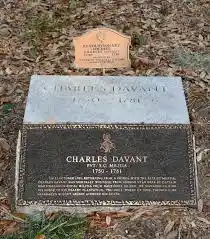
Born in 1750 on Edisto Island into a family of English-Huguenot descent, Charles Davant moved to Hilton Head Island as a child. Along the northwest shore of Broad Creek, he carved out a life as an indigo planter at his estate, Two Oaks Plantation. Like many of his neighbors, Davant was a man of the soil whose life was upended by the encroachment of war. When the Revolution began, he answered the call to arms, serving in a mainland patrol unit of the Lower Granville Regiment under Colonel Benjamin Garden.
The Ambush at the Big Gate
After the fall of Charleston in 1780, Davant returned to Hilton Head to join the local militia in a desperate, “hit-and-run” resistance against British and Loyalist forces. The conflict became deeply personal in the fall of 1781, as a Loyalist militia from Daufuskie Island, led by the notorious Captain Philip Martinangele, began raiding Patriot homes along Skull Creek.
On the night of October 21, 1781, Davant was part of a Patriot patrol scouring the island’s southern shores. Finding no sign of the enemy, the patrol disbanded at the muster house near the headwaters of Broad Creek. As Davant and his comrade, John Andrews, rode toward their homes, they reached a cattle gate known as the “Big Gate.” Unbeknownst to them, Martinangele’s men had rowed up the creek with padded oars and lay in wait. As Davant leaned down to unlatch the gate, the trap was sprung. A volley of musket fire erupted from the darkness, mortally wounding Davant and injuring Andrews.
A Dying Command
Though bleeding profusely, Davant clung to his horse as it galloped nearly two miles back to Two Oaks. His wife, hearing the distant shots and the frantic hoofbeats, rushed out to meet him. In his final moments, Charles Davant identified his killer, whispering a command that would haunt the island for months: “Get Martinangele. The Legacy of the “Bloody Legion”
Charles Davant holds the somber distinction of being the only known Patriot killed-in-action on Hilton Head Island during the entire war. His death sparked an immediate and brutal response from the “Bloody Legion.” On December 23, 1781, a retaliatory party—led by Charles’s own brother, James—crossed the Calibogue Sound under the cover of night. They infiltrated Martinangele’s home on Daufuskie Island and executed the Captain in his bed, burning the house to the ground in an act of grim symmetry.
Davant’s sacrifice remains a cornerstone of Hilton Head’s Revolutionary history. He was a man who died defending his doorstep, and his story serves as a stark reminder of the “neighbor against neighbor” violence that once stained the marshes of the Lowcountry.